
Blog
What an RV Starter Kit Includes—and What It Usually Leaves Out

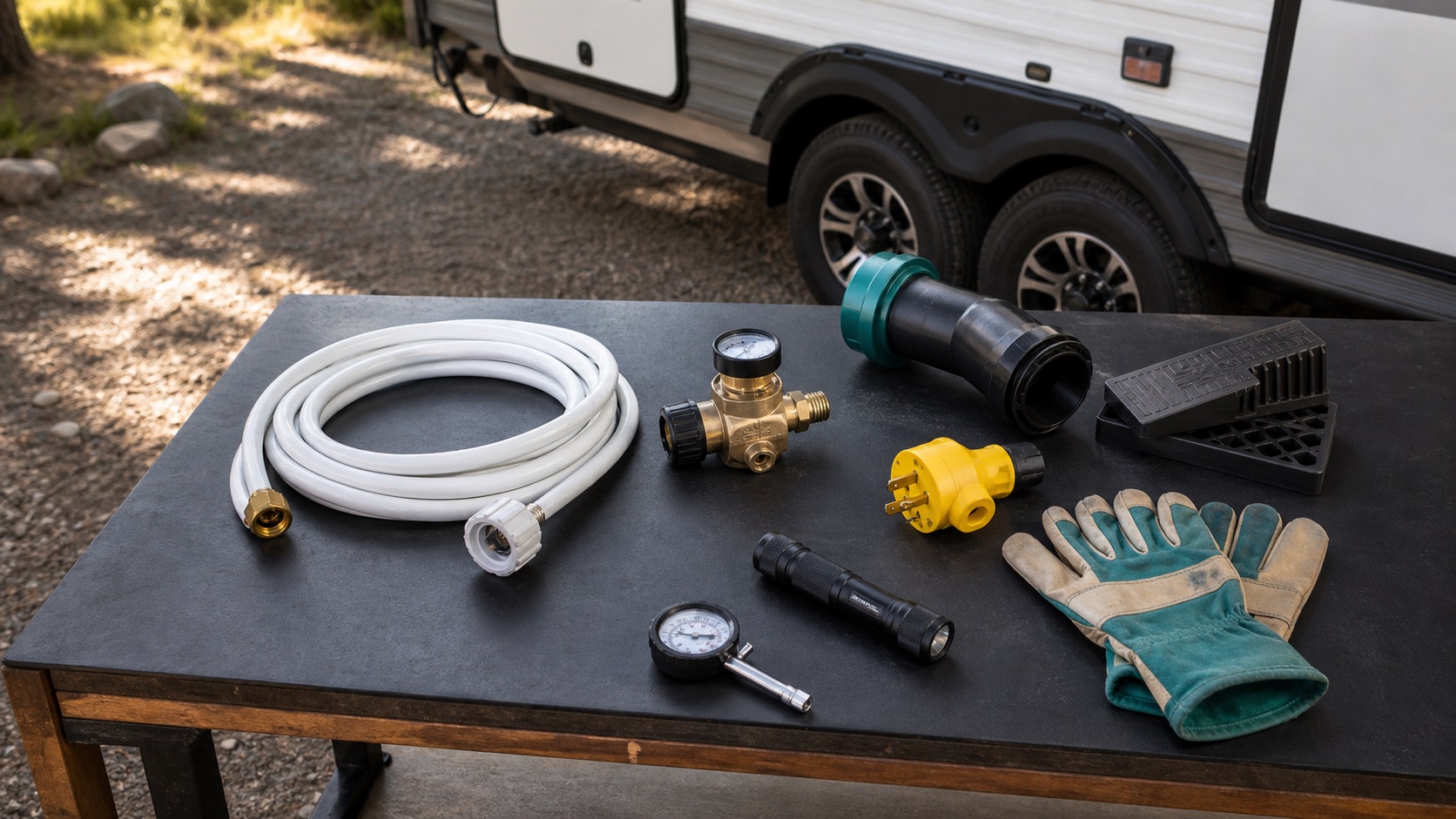
Quick answer: Most “RV starter kits” are component bundles, not a complete first-trip checklist. Confirm the exact contents, then fill the gaps across five systems: potable water, wastewater, shore power, leveling/chocking, and road safety. Match amperage, connector type, pressure limit, hose length, outlet fitting, dimensions, and pack quantity before buying.
What an RV starter kit really is
A starter kit is best treated as a shortcut for buying several basic accessories together. The name does not define a standard set of parts. One box may focus on a sewer hose and fittings; another may add a drinking-water hose and regulator; another may include inexpensive electrical adapters but no protective power device. Two kits with similar photos can therefore solve very different problems.
The useful question is not “Does this say starter kit?” It is “Which campsite systems can I safely connect with the exact items in this box?” Read the included-item list line by line. A product photo can show accessories that are not included, while a title may omit hose length, fitting style, or sell quantity.
The five-system starter checklist
Use this table as a gap check, not as a universal shopping list. Your RV manual, tire placard, electrical service, plumbing limits, campground rules, and existing equipment remain authoritative.
| System | Useful minimum | Common omission | Exact fields to match |
|---|---|---|---|
| Potable water | Dedicated drinking-water hose and pressure regulator; an inline filter when wanted | A hose long enough for the sites you use, spare washers, or a regulator with a readable gauge | RV pressure limit, hose length, thread, regulator range, filter service interval |
| Wastewater | Sewer hose, RV-end connection, dump-station elbow/adapter, storage caps, and gloves | A hose support, extension, clear inspection fitting, or adapter for the campground inlet | Total length, bayonet/lug style, outlet thread, included fittings, storage dimensions |
| Shore power | Cord and only the adapters required for the RV’s service | A correctly rated power-protection device or a safe way to inspect pedestal condition | 30A/50A service, plug and receptacle configuration, voltage, weather rating, protection functions |
| Level and secure | Wheel chocks and leveling method appropriate to the RV | Jack pads, a small level, or enough blocks for uneven sites | Vehicle weight, tire size, jack-foot size, block rating, manufacturer placement instructions |
| Road and setup safety | Tire-pressure gauge, flashlight, basic hand protection, and an emergency kit | Spare-tire access tools, a torque tool, spare fuses, or a written departure checklist | Cold tire pressure from the placard/manual, lug torque, fuse type/rating, tool sizes |
Potable water: keep it separate and pressure-aware
Use a hose intended for drinking-water service, and keep it physically separate from wastewater equipment. Camco’s first-time RVer guidance recommends a dedicated potable-water hose and describes a typical regulator range of about 40–50 psi. That range is a general accessory reference, not permission to exceed the limit in your RV manual. Install and use the regulator as its manufacturer directs, then check every visible connection for leaks.
Wastewater: connection is only half the job
A sewer kit should identify the hose length and every included fitting. At many sites, the missing piece is a support that maintains a consistent downward slope. Camco notes that a support can reduce pooling and backups. Also check how the hose will be capped and stored; a loose hose and an unprotected potable-water hose should never share the same compartment.
Shore power: an adapter is not protection
An adapter changes which connectors can mate; it does not automatically add surge, low/high-voltage, open-neutral, open-ground, reverse-polarity, or overheat protection. Southwire separates basic connection products from devices designed to monitor or disconnect faulty power. Match the RV service and the exact protection functions rather than treating every yellow or black plug as equivalent.
Chocking, leveling, and tire checks
Secure the RV against movement before concentrating on hookups. Follow the RV and leveling-equipment instructions for placement and load. For tires, use the recommended cold inflation pressure on the vehicle label or in the owner’s manual—not the maximum pressure molded on the tire sidewall. NHTSA recommends checking all tires, including the spare, when cold and carrying an accurate gauge.
What a bundle usually leaves out
- Vehicle-specific limits: the correct water pressure, electrical service, tire pressure, lug torque, jack points, and weight ratings.
- Site-specific reach: extra potable-water or sewer length for unusually placed hookups.
- Consumables: hose washers, filters, approved toilet products, gloves, spare fuses, and cleaning supplies.
- Inspection tools: a flashlight, tire gauge, small multimeter used only by someone qualified, or a pedestal tester/protection device appropriate to the system.
- Storage separation: bins or bags that prevent wastewater parts from contacting potable-water equipment.
- A departure routine: a written walk-around catches disconnected cords, open vents, loose steps, raised jacks, and unsecured doors better than memory.
How to compare two starter kits
Normalize the contents before comparing price. Write down each included part, its size or length, and the sell quantity. Then mark whether it is an exact-use item, a spare, or something you already own. A lower-priced kit is not cheaper if its hose is too short, its adapter does not match, or its fittings need immediate replacement.
- Confirm the sell unit. “Kit,” “set,” and a multi-item photo do not prove how many of each part are included.
- Match interfaces. Check plugs, receptacles, threads, bayonet lugs, hose diameter, and connection gender.
- Match ratings. Verify amperage, voltage, pressure range, load rating, and temperature/weather limits.
- Check usable length. Compare total hose or cord length after fittings and routing, not only the headline number.
- Price the omissions. Add the regulator, support, adapter, storage, or protection device you still need.
- Check replacement support. Filters, caps, seals, and worn hose sections should be obtainable without replacing the whole system.
A practical first-arrival order
Use the procedure supplied with your RV and campsite. As a general organization aid: park where the utility connections can reach without tight bends; set the parking brake; secure and level the RV; visually inspect the electrical pedestal with power off; make the potable-water connection with the correct regulator; and connect wastewater equipment only when needed. Keep caps and gloves controlled so nothing contaminates the fresh-water side.
Before leaving, reverse the process methodically and perform a full walk-around. Check the ground and compartments for forgotten fittings, chocks, caps, tools, cords, hoses, and leaks.
Stop and correct the problem before continuing if you find:
- a burnt, melted, loose, wet, or damaged shore-power plug or receptacle;
- an electrical fault indication you do not understand;
- a potable-water hose or fitting that has contacted wastewater equipment;
- a sewer connection that leaks or cannot be secured;
- a bulged, cut, cracked, or visibly damaged tire; or
- any component whose rating, fit, or included quantity cannot be confirmed.
Disconnect power before inspecting electrical connections. Use a qualified RV technician or electrician for damaged wiring, pedestal faults, or work beyond the checks permitted by your manuals.
RV starter kit FAQ
Does every new RV come with a sewer hose and drinking-water hose?
No universal contents standard applies. Treat dealer-supplied accessories and retailer bundles as separate line items and verify the handover inventory before the first trip.
Is a pressure regulator always necessary?
Campground pressure can vary. A regulator is a common protective accessory, but its range and installation must comply with the RV plumbing limit and the regulator instructions.
Can a 30A-to-50A adapter give my RV 50 amps?
No. An adapter cannot create capacity that the source circuit does not provide. Match the source, adapter configuration, RV service, and circuit protection; do not overload the available supply.
What should I buy before taking delivery?
Start with the RV manual and the dealer handover list. Confirm shore-power service, water-pressure limit, tire and lug specifications, wastewater connection, leveling method, and what is physically included. Then fill only the proven gaps.
Not sure whether a kit actually fits your setup?
Send the kit part number or a clear label photo, plus your RV model, electrical service, and the connections you need to match. Email sales@parts4campers.com.
Browse current fresh-water hoses, pressure regulators, and sewer hoses.
Primary sources
- Camco: Quick Lessons for First-Time RVers — drinking-water hose, pressure regulator, sewer support, and setup essentials.
- Camco: Ask the Expert—Your Toughest RV Questions Answered — common water, wastewater, leveling, and electrical accessories.
- Southwire: Recreational Power — connection products and power-protection functions.
- NHTSA TireWise — cold-pressure checks, placard/manual pressure, spare-tire checks, and carrying a gauge.